The seven-year Partnership for Resilient and Inclusive Small Livestock Markets (PRISM) project, valued at $28 million, is poised for renewal for another 3–5-year phase. Yet in Gisagara District, beneficiaries are already putting in place sustainable models to preserve and advance the project’s gains.
Jointly funded by the International Fund for Agricultural Development (IFAD), Enabel, Heifer International, and VSF Belgium, and implemented by the Government of Rwanda, the PRISM project aims to reduce poverty and improve food security by strengthening small livestock value chains across 15 districts. It targets rural men, women, and youth engaged in livestock markets.
Through PRISM, beneficiaries have received support to acquire and rear livestock which are mainly chickens, goats, and pigs—as reliable sources of nutrition and income. They were also trained in modern livestock practices, finance, cooperative management, and the formation of Self-Help Groups (SHGs) to grow their enterprises.
Since 2021, PRISM has distributed 88,877 animals, trained 27,969 farmers, and supported the formation of 1,291 SHGs, including 960 poultry and 346 piggery groups.
In Gisagara District specifically, 2,744 beneficiaries received 15,290 chickens, 1,452 goats, and 750 pigs across Muganza, Nyanza, Kigembe, Gishubi, and Gikonko sectors. A total of 4,275 farmers were trained under the Values-Based Holistic Community Development (VBHCD) model, contributing to the district’s 26,355 targeted households in small livestock value chains. Seventy-nine SHGs were formed, including 59 focused on poultry and 20 on piggery.
According to Augustin Bucyana, president of Abesamihigo Nyanza Cooperative, which manages 20 SHGs, the project transformed individual households into small businesses.
Augustin Bucyana, president of Abesamihigo Nyanza Cooperative
“For instance, 439 beneficiaries each received 10 chickens, and within months, flocks had doubled. Members were already earning income every 21 days,” Bucyana said. “We saw improved incomes and welfare, but we also realized PRISM was a bigger gift and we wanted to ensure it benefited the wider community.”
The group recognized the need for a sustainable system, forming the Abesamihigo Nyanza Cooperative in 2022 to consolidate operations. However, they soon faced a common challenge of limited access to affordable feeds.
“Members who previously earned nothing were now making about Rwf20,000 per week,” said Bucyana. “That success motivated us to work collectively, leading to the idea of forming the cooperative.”
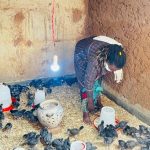
Under cooperative management, members contributed to purchase a Rwf500,000 facility that serves as both an office and a center for growing azolla and rearing chickens. The number of chickens rose from 500 to 750 in three months, enabling the cooperative to earn Rwf53,000 in profits, while individual members continue to make around Rwf20,000 monthly. The number of azolla feed clients has also increased—from one to 25 farmers.
Through PRISM’s Passing On the Gift (PoG) model, which encourages beneficiaries to share livestock offspring with new households, the cooperative is currently in its third round of distribution.
One of the program’s success stories is Deo Hashimamungu from Rugomero Village, who received two goats and has since expanded his herd to 41 goats within two years. He has now started a goat breeding service, charging Rwf1,000 per service, and actively contributes to local savings groups.
Despite these successes, the continued challenge of feed costs pushed the cooperative to innovate. Guided by PRISM Community Champions of Change, members hired an expert in azolla and hydroponic-based animal feeds.
“Factory-made feeds were too expensive, so we tested azolla and hydroponic systems as complementary solutions,” Bucyana explained. “We saw not only lower costs but also better egg quality and consistent production throughout the year.”
Currently, the cooperative produces 30 kilograms of azolla feeds daily and sells to other farmers. Seventy percent of members have already adopted the technology, with plans to extend it to 100 additional households by year’s end.
According to Jean Paul Habineza, Vice Mayor of Gisagara District in charge of Economic Development, PRISM has been invaluable in empowering vulnerable families through livestock distribution and training.

Jean Paul Habineza, Vice Mayor of Gisagara District in charge of Economic Development
“The district is addressing the feed challenge by establishing an industrial park that will attract investments in animal feed production,” Habineza said. “We are also negotiating a grant to subsidize 60% of the cost of chopper machines for farmers, enabling them to produce their own feeds from agricultural waste.”
The Gisagara experience shows that PRISM’s impact goes beyond livestock supply creating a sustainable model that improves incomes, nutrition, and resilience among rural households.