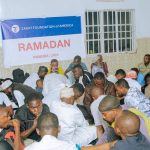
As the sun sets over Gatsibo District, the call to prayer echoes from Gatoki Mosque. Families and neighbors gather, their hearts filled with gratitude, to break their fast. Plates of Matoke, rice, posho, meat and porridge—generously provided by the Abdullah Kiromba Foundation and the Zakat Foundation of America—are shared in a spirit of unity and faith.
For Zubbenda Mukamana, a mother of five from Gatoki Cell in Kaborore Sector, this Ramadan marks a deeply personal milestone. Having embraced Islam last year, she now fasts alongside millions of Muslims worldwide.
“Last year, I couldn’t fast because of illness,” she recalls. “But this year, thanks to Allah, I have observed Ramadan without any problems.”
Zubeda Mukamana during evening prayers at Gatoki Mosque in Gatsibo District
Mukamana’s journey to Islam was shaped by spiritual encounters and the warmth of the Muslim community. “The teachings of Islam—devotion, love for one another, prayer, and submission to Allah—created a welcoming environment for me,” she says.
She often prays at Gatoki Mosque, where she has found a renewed connection to her heritage and faith. Her daughter has also embraced Islam, and together, they observe Ramadan, finding strength in shared prayers and communal iftar meals.
“I am grateful to the Abdullah Kiromba Foundation and the Zakat Foundation of America for ensuring that families who might struggle to afford iftar can break their fast with dignity,” she adds.
For many new Muslims in Gatsibo, embracing Islam is both a spiritual and communal experience. Yusufu Nzamwita, a 33-year-old father of two also converted and has found faith. He and other young converts gather daily after farm work to study Islamic teachings—an enriching routine that has deepened their faith and strengthened their sense of belonging.
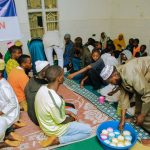
Yusufu Nzamwita (white shirt) sharing Iftar with his fellow Muslims at Gatoki Mosque
The holy month of Ramadan has become a special time for Nzamwita. Every evening, he comes to Gatoki Mosque for prayers and to break his fast. Sharing iftar with his fellow Muslims is a meaningful occasion for him, and he is deeply grateful to the mosque for providing daily meals to all who come.
“Islam has changed my outlook on life,” Nzamwita shares, his face glowing with fulfillment. “It has given me peace, a deeper connection to my community, and a sense of direction as a young man.”
According to the 2022 Rwanda Population and Housing Census, between 12% and 15% of the country’s 14 million people practice Islam—an estimated 1.8 to 2 million Muslims. As the faith continues to grow, so does the sense of unity among those who embrace it, proving that Islam is not just a religion but a way of life that fosters community, love, and spiritual fulfillment.