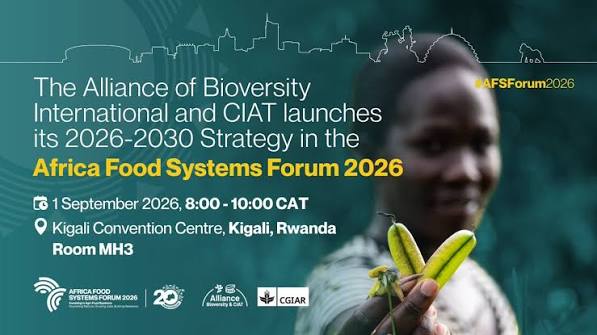
The Alliance of Bioversity International and CIAT will launch its 2026-2030 strategy for Africa in Kigali next week, putting science, investment and partnerships at the centre of efforts to make the continent’s food and land systems more resilient and sustainable.
The strategy will be unveiled on Sept. 1 during a high-level side event at the Africa Food Systems Forum at the Kigali Convention Centre, following the global launch of the Alliance’s five-year strategy in July.
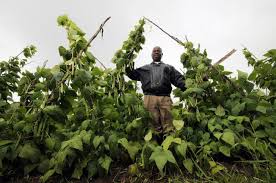
The new strategy comes as Africa’s food systems face growing pressure from climate change, biodiversity loss, land degradation, inequality, population growth, urbanisation and changing diets.
The Alliance said it would focus on turning scientific evidence and innovation into practical solutions that farmers, communities, policymakers, businesses and other stakeholders can use.
The strategy identifies four priorities for Africa: linking science and sustainability, promoting more inclusive food systems, strengthening partnerships and mobilising finance to scale solutions.
The Alliance said food systems transformation would require greater access to evidence and tools to help farmers, policymakers, businesses, innovators and consumers make informed decisions.
Investment will be a major focus of the Kigali launch. The Alliance said financial resources were not only an enabler but also a means of accelerating the adoption of proven solutions.
The event will bring together representatives from the science and investment communities to discuss how evidence can help direct capital towards initiatives that strengthen food security, create jobs, protect ecosystems, conserve biodiversity and improve livelihoods.
The strategy is aligned with the Alliance’s global theme, “Resilient Futures: Urgent Science for Food and Land Systems Transformation.”

Juan Lucas Restrepo, Director General of the Alliance of Bioversity International and CIAT
The Africa Food Systems Forum, taking place in Kigali, is being held under the theme “Investing in Africa’s Agri-Food Systems: Nourishing Nations, Growing Jobs, Building Resilience.”
The Alliance said expanding financing for agricultural research and food systems transformation could involve commercial markets, natural-capital instruments and blended finance.
Juan Lucas Restrepo, Director General of the Alliance of Bioversity International and CIAT, said Africa could build on its agricultural biodiversity, indigenous knowledge, entrepreneurial energy, youthful population and scientific capacity.
“Food and land systems are simultaneously among the sources of some of the planet’s most urgent challenges and among its most powerful levers for change,” Restrepo said.
Dr. Wanjiru Kamau-Rutenberg, Managing Director for Africa at the Alliance, said scientific research needed to respond to the realities faced by people who depend on food systems.
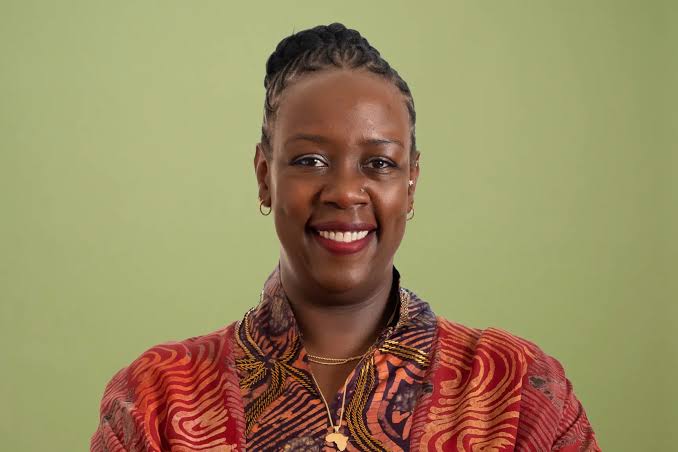
Dr. Wanjiru Kamau-Rutenberg, Managing Director for Africa at the Alliance
“A farmer needs to know when to plant, what to plant and how to manage risk,” she said.
Kindie Fantaye, Head of Climate Adaptation, Sustainable Agriculture and Resilience at AGRA, said science and implementation needed to move together.
“Science alone does not change anything. And scaling without science does not mean anything either,” he said.
The Alliance said no single institution could transform Africa’s food and land systems alone. It called for stronger cooperation among governments, researchers, farmers, communities, businesses, investors and development partners.
“We look forward to deepening our collaborations with the Rwanda Government to impact positively on the food systems in the face of the challenges,” said Dr. Eliud Abucheli Birachi, the Country Representative of Alliance Bioversity & CIAT Rwanda.
Through the new strategy, the Alliance aims to connect science, evidence, investment and partnerships to accelerate practical solutions for more resilient, inclusive and sustainable food and land systems across Africa.