Farmers attending Rwanda Agricultural Show 2026 are returning home with more than new business contacts and exhibition experience—they are taking back practical knowledge, modern technologies, and renewed ambition to transform agriculture from subsistence farming into profitable agribusinesses.
For many first-time exhibitors, the 19th Rwanda Agricultural Show has become an open-air classroom where farmers are learning directly from one another about mechanization, climate-smart agriculture, value addition, irrigation, and market access—lessons they believe will significantly boost productivity in the coming farming seasons.
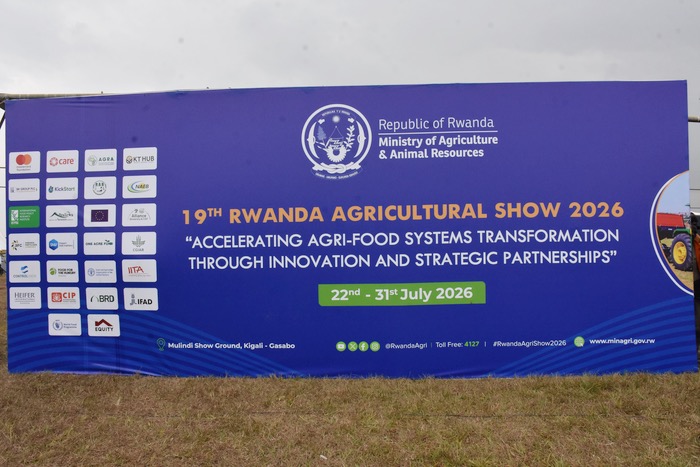
Held from July 22 to July 31 at the Mulindi Agricultural Showgrounds in Gasabo District, this year’s exhibition has attracted a record 600 local and international exhibitors, including hundreds of rural farmer cooperatives, agribusinesses, researchers, development partners and university-led innovations. The exhibition, themed “Accelerating Agri-Food Systems Transformation through Innovation and Strategic Partnerships,” has become a national platform for exchanging technologies and practical farming solutions.
Many participating cooperatives have benefited from the Commercialization and De-Risking for Agricultural Transformation (CDAT) project and the Sustainable Agricultural Intensification and Food Security Project (SAIP II), financed by the World Bank and the International Fund for Agricultural Development (IFAD), and coordinated through the Rwanda Agriculture and Animal Resources Development Board (RAB) Single Project Implementation Unit (SPIU). Their success stories demonstrate how combining financing with technical skills can fundamentally change rural livelihoods.
Among the standout exhibitors is Iterambere ry’Abahinzi Borozi ba Makera (IABM) Cooperative from Muhanga District, whose journey illustrates the transformation that can occur when farmers adopt improved agricultural practices.
The cooperative, which brings together 1,856 members organized into 60 groups—including 1,000 women and 127 youth—has evolved from producing low-yield crops into a commercially oriented enterprise manufacturing certified hybrid maize seeds and its own branded maize flour, “Ishema rya Makera.” The cooperative also exports French beans through support from CDAT and the National Agricultural Export Development Board (NAEB).
Cooperative IABM officials showcasing their high quality maize flour at the Agric Show 2026
Its chairperson, Uzamukunda Yukunda, says technical support has been just as valuable as financial investment.
“CDAT helped us turn farming into a profitable business,” she said.
Before receiving support, members lacked knowledge about proper fertilizer application, soil fertility management and compost production. Through continuous training, exchange visits and technical guidance, they mastered compost making using crop residues, precision fertilizer application and small-scale irrigation.
“CDAT has helped us solve many daily challenges in our fields. Before their intervention, we did not know the right quantity of fertilizer to use, nor did we know how to prepare organic fertilizer from crop waste,” Yukunda explained.
“Through study tours, our members gained practical skills to increase production, reduce input costs by learning how to make compost manure, and how conserve our land fertility. This technical support has also unlocked broader market access.”
The results have been remarkable.
According to the cooperative, compost production and improved agronomic practices have tripled certified seed productivity from 100 kilograms to 300 kilograms per season while increasing maize flour processing capacity from three to five tonnes daily due to increased harvests.
“We want to excel in making compost manure to be an example to other farmers in the district,” Yukunda said.
“This compost has enabled us to increase seed productivity from 100kgs to 300kgs per season, but also improved quality of flour and able to mill from at least 3 to 5 tons per day because of the increased produce.”
She added that adopting improved seeds, recommended crop spacing and organic fertilizer has transformed productivity across the cooperative.
Today the cooperative operates a modern maize processing plant and, through a CDAT-supported loan, has invested in a Rwf14.8 million maize drying facility, new storage warehouses and a standards office—investments positioning it to compete in larger commercial markets.
Beyond showcasing products, however, many first-time exhibitors say the greatest value of the agricultural show lies in learning from others.
Several cooperatives from Rusizi District described the exhibition as an opportunity to identify technologies capable of solving long-standing production bottlenecks.
Dutezimbere Ubuhinzi Kw’Ishara Cooperative (KODSHARA), established in 2015 with 84 members, has used SAIP II support to invest in irrigation equipment, compost production, transportation and modern farming practices.
Vice-Chairperson Jacqueline Uwamahoro says visiting other exhibition stands exposed members to practical innovations they had never imagined.
“We have learnt a lot from this agric show especially that it is possible to grow animal feeds using grass stems as opposed to collecting grass feeds from the field. We use hands to husk corn seeds which takes weeks to husk 10-15 tons but we have seen a husking machine that we can purchase to help do 20 tons in an hour,” Uwamahoro said.
She explained that before receiving SAIP II support, members could only cultivate maize and beans because they lacked irrigation infrastructure.
Today the cooperative grows high-value vegetables including tomatoes and capsicum during the dry season while also managing three hectares of mango orchards and producing compost to improve soil fertility and reduce dependence on chemical fertilizers.
These interventions, she noted, have diversified incomes while making the cooperative more resilient to climate variability.
Another Rusizi-based cooperative, Abunze Ubumwe Nyakabuye (KOANYA), has similarly discovered that information can be just as valuable as financing.
The 54-member cooperative specializes in avocado production, seedling nurseries and organic compost.
Its President, Maurice Nzeyimana, said participation in the show has opened members’ eyes to export opportunities and profitable horticultural enterprises beyond their traditional markets.
“We produce high quality avocado fruits and we have been selling to only the Rusizi market because we had no information on available deals. Participating in the agricultural show has opened us to learn about other markets, and the need to diversify to more profitable horticulture products such as mushroom, tomatoes and pepper,” Nzeyimana said.
For watermelon growers from Cooperative Twitezimbere Muhinzi Nzahaha (KOTAMUNZA1), the lessons were even more technical.
Cooperative President Francois Mbonankira said members discovered that poor harvesting techniques and low-quality seed varieties had been silently reducing both yields and product quality.
“We have learnt a lot from other farmers, for example, that we have been planting using poor quality seeds yet there are better seeds on the market. We have been poorly severing the watermelon stem during harvesting, which has affected our quality without knowing. This knowledge is vital thanks to SAIP sponsoring us to learn from others,” Mbonankira said.
The emphasis on farmer-to-farmer learning aligns closely with the government’s broader vision of modernizing agriculture through innovation.
Opening the exhibition, Minister of Agriculture and Animal Resources Dr. Telesphore Ndabamenye urged farmers to embrace new technologies and strategic partnerships to build resilient agri-food systems capable of withstanding climate change and rising production costs.
He noted that agriculture remains central to Rwanda’s economy, contributing approximately 20 percent of the country’s Gross Domestic Product while supporting nearly 70 percent of processing industries.
Under the Second National Strategy for Transformation (NST2), Rwanda aims to increase production of priority crops by 50 percent while sustaining annual agricultural growth above six percent.
To encourage investment, government has expanded fertilizer subsidies and introduced concessional agricultural financing, reducing interest rates on agricultural loans to half of prevailing commercial bank lending rates.
According to the minister, more than Rwf55 billion in agricultural financing has been approved during the past three years, with over Rwf30.9 billion already disbursed through 31 participating financial institutions.
By 2029, Rwanda targets doubling private sector investment in agriculture from US$2.2 billion to US$4.6 billion, increasing agricultural export earnings from US$893.16 million to US$1.9 billion and raising agriculture’s share of commercial lending from six percent to at least 10 percent.
The minister encouraged exhibitors not to leave the agricultural show with only business cards or exhibition certificates but with practical skills that can immediately improve productivity during the upcoming 2027 Season A planting period.
Since its establishment in 2003, the Rwanda Agricultural Show has evolved beyond a traditional exhibition into one of the country’s most influential knowledge-sharing platforms, bringing together farmers, researchers, investors, development partners and policymakers to exchange technologies, strengthen partnerships and accelerate the modernization of Rwanda’s agriculture under the Fifth Strategic Plan for Agriculture Transformation (PSTA5).
For many rural farmers, this year’s exhibition has reinforced one clear message: increasing production is no longer dependent solely on expanding farmland, but on adopting better technologies, improving farming knowledge, embracing value addition and learning continuously from those who have already succeeded.
As they return to their communities, these lessons are expected to spread beyond individual cooperatives, helping more farmers transition from subsistence agriculture to competitive agribusiness.