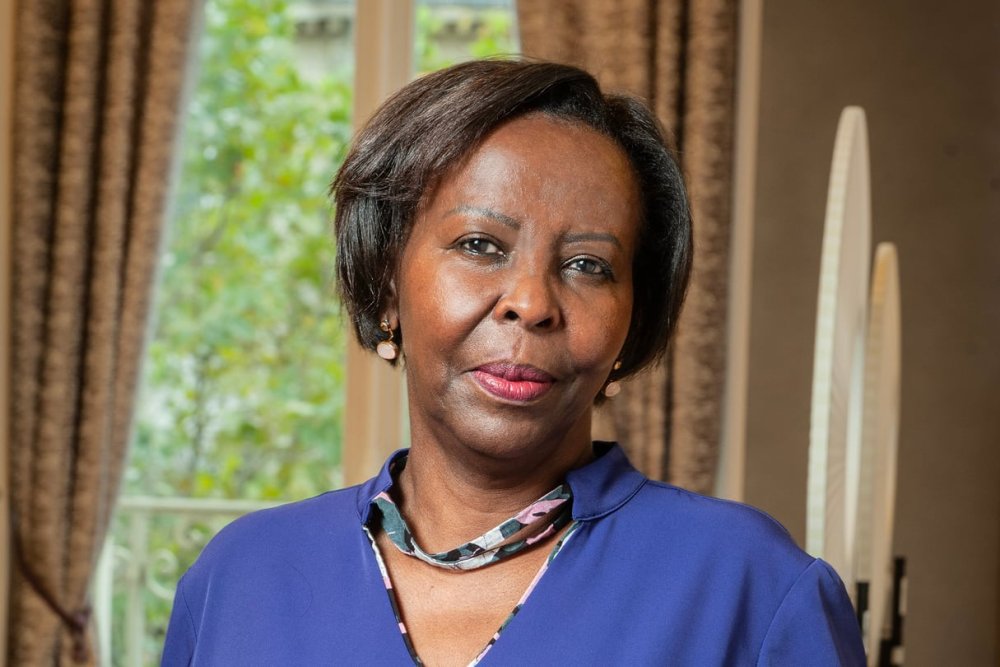
The 1994 Genocide against the Tutsi changed how Louise Mushikiwabo viewed life, family and time, an experience she says continues to shape her outlook as she seeks a third term as Secretary-General of the International Organisation of La Francophonie (OIF).
In an interview with Africa 24, Mushikiwabo spoke about losing relatives during the genocide and the long process of documenting her family’s history in a memoir, Rwanda Means the Universe: A Native’s Memoir of Blood and Bloodlines.
She said the loss taught her to value life and avoid spending time on matters that do not deserve it. It also strengthened her desire to understand and explain Rwanda’s history, including the experiences of people whose lives were cut short.
Mushikiwabo said she wanted the book to preserve the identities of those who died: who they were, what they enjoyed and the roles they played in the lives of others. She did not want them to be remembered only as numbers among the victims of the genocide.
The writing took about 10 years. Researching her family’s past and speaking with people about shared memories also helped her deal with grief, allowing her to recall happier moments while documenting the history that led to the genocide.
Mushikiwabo grew up in a family of nine children, with seven boys and two girls. She described her childhood as happy and said her close family relationships remained important to her, despite the losses suffered in 1994.
She left Rwanda for the United States in 1986. While studying and working there, she learned to manage her own finances, organise her thoughts and express her opinions. She had initially studied science in secondary school but later developed an interest in languages and literature.
Her professional career took her to Tunisia, where she worked in communications at the African Development Bank, preparing speeches and writing for senior officials. She returned to Rwanda in 2008 after being invited to serve in government, first as Minister of Information and government spokesperson and later as Minister of Foreign Affairs and Cooperation, a role she held for a decade.
In October 2018, she became the first African woman elected to lead the OIF. She was re-elected in 2022 and is now seeking another term, with the election scheduled for November 16 in Phnom Penh, Cambodia.
Mushikiwabo said she remained committed to the organisation and believed it still had considerable potential to contribute to French-speaking countries.
“I love what I do, and I still have a lot of energy to serve this organisation,” she said.