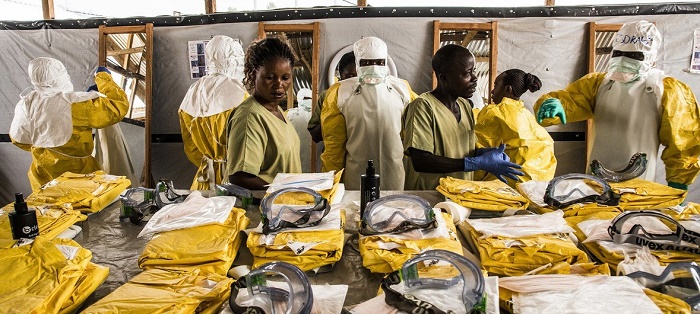
Frontline health workers battling the deadly Bundibugyo Ebola outbreak in eastern Democratic Republic of Congo are facing an enemy beyond the virus itself: fear, misinformation, and violent resistance from communities they are trying to save.
The World Health Organization (WHO) says health workers are fighting what it describes as a “double war”, one against the rapidly spreading Ebola outbreak and another against deep community mistrust, rumors, and physical attacks that are undermining containment efforts in towns such as Bunia.
According to the WHO, as of late May 2026, the outbreak has escalated to more than 740 suspected cases and over 170 deaths. The virus has spread from its epicenter in Ituri Province to major urban transit hubs including Bunia and Goma, and has even crossed the border into Kampala, Uganda.
Unlike the more common Zaire strain, the Bundibugyo virus has no approved vaccine or specific antiviral treatment. This has left containment efforts heavily dependent on early isolation and contact tracing, strategies now struggling under the weight of misinformation and public distrust.
In cities like Bunia, resistance to medical intervention has turned increasingly volatile. WHO officials say response teams operating in conflict-affected neighborhoods have been pelted with stones and subjected to verbal abuse while trying to carry out containment measures.
“We continue to tell them that the disease is out there. Some accept, and others don’t,” a local health worker said.
Humanitarian organizations, including ActionAid and Mercy Corps, say deep skepticism remains widespread across the region.
The WHO and local health authorities have identified three major myths driving the current surge in infections.
The “Fabricated Crisis” and Institutional D
In communities already exhausted by years of armed conflict, displacement, and economic hardship, trust in institutions remains extremely fragile.
A growing narrative has emerged that the Ebola outbreak is either exaggerated or entirely fabricated by foreign NGOs and local officials seeking international funding.
Believing the disease is not real, many people showing symptoms are avoiding isolation centers and remaining at home. In some cases, the denial has escalated into violence, including attacks on medical tents and treatment facilities.
2. The Tragedy of Traditional Burials
One of the biggest flashpoints between public health officials and local communities involves burial practices.
WHO officials say the recent spike in infections was significantly accelerated by a funeral held in early May. According to health authorities, a family in Bunia reopened a coffin to transfer a deceased relative into another casket before transporting the body to Mongbwalu for traditional burial rites.
Traditional funeral customs involving washing, dressing, and touching the deceased remain one of the main drivers of Ebola transmission.
Health experts warn that Ebola patients carry extremely high viral loads at the time of death, making bodies highly contagious. When safe burial protocols are ignored, a single funeral can quickly become a super-spreader event.
3. Panic Over Casual Transmission
WHO officials also warn that while denial is helping spread the virus locally, misinformation online is fueling unnecessary panic elsewhere.
A widespread misconception persists that Ebola is airborne or can be spread by people who are not showing symptoms.
The WHO says the virus cannot be transmitted during its incubation period, which ranges from two to 21 days. Unlike respiratory illnesses such as the flu, Ebola spreads through direct contact with the bodily fluids — including blood, sweat, or vomit — of an infected person who is actively symptomatic.
Public health officials say understanding these transmission limits is critical both for protecting health workers and preventing unnecessary fear.
A Response System Under Pressure
The outbreak response has also been complicated by a dangerous four-week delay between the suspected index case in late April and official laboratory confirmation in mid-May.
Initial tests conducted in Bunia reportedly came back negative for the more common Zaire strain, allowing the virus to spread undetected for weeks before samples sent to Kinshasa confirmed the presence of the Bundibugyo strain.
With potential vaccine candidates still months away, the WHO says it is now focusing heavily on community engagement and risk communication.
“It is only when communities are engaged in the response that such outbreaks are brought under control,” the WHO said, stressing that medical supplies and protective equipment are ineffective if health workers cannot safely access affected communities.